

Published on May 28, 2026
12 min to read
Social Media Algorithm 101: Understanding What Performs Well

Summarize with AI

Table of contents
Summarize with AI

ChatGPT

Claude

Perplexity
Share

Vista Social

X (Twitter)


You spend an hour recording a Reel, nail the hook, post it at the perfect time, and it gets 200 views. Meanwhile, a random cat video from a brand new creator with less than 1,000 followers hits two million overnight.
That’s the social media algorithm deciding who gets seen and who gets buried, and in 2026, the rules behind those decisions have changed more than most people realize.
If you manage social media for a brand, you’ve probably felt this shift already. Organic reach is dropping, posts that used to perform are falling flat, and the old advice about hashtags and posting times doesn’t move the needle anymore.
This guide breaks down what a social media algorithm actually is, how each major platform’s algorithm works right now, and a framework you can use across every network you’re managing.
Table of contents
How social media algorithms work in 2026
Most guides on social media algorithms jump straight into platform-specific signals. That approach gives you a list of 50 things to optimize across eight platforms, which nobody can actually remember.
It helps to understand the cross-platform pattern first, so platform specifics become variations on a theme you already know.
The universal signal stack in 2026
Every major social platform uses some combination of the same seven core signals.
The weights differ by network, but the signals themselves are remarkably consistent:
- Predicted engagement is the likelihood you’ll like, comment, share, save, or send a post based on your past behavior. If the system predicts you’ll interact, the content gets shown.
- Content-interest match looks at whether a post’s topic and style align with what you’ve engaged with before. The algorithm asks “does this person care about this topic?” rather than “does this person follow this creator?”
- Watch time and dwell time measure how long you actually spend on a post, and this signal now outweighs likes on every video-forward platform.
- Engagement velocity tracks how fast a post earns interaction in its first 30 to 60 minutes, since early momentum tells the algorithm whether to push content wider.
- Relationship signals look at your past interactions with the creator, including DMs, profile visits, saves, and comment threads.
- Content quality signals evaluate whether the content is original and native to the platform, and cross-posted content with watermarks from another platform gets penalized.
- Recency still matters, though less than in 2022 when chronological feeds were more common.
These signals get weighted differently depending on where you’re posting.
For example, TikTok weighs completion rate and watch time heaviest, while Instagram’s head Adam Mosseri has confirmed that the top three are average watch time, likes per reach, and sends per reach. LinkedIn prioritizes professional context and dwell time, but the underlying stack is the same everywhere.
When you internalize that these same seven signals drive every platform, you stop chasing platform-specific hacks. Instead, you start optimizing for the underlying mechanics that work universally: native content, strong hooks, watch-time-friendly structures, fast early engagement, and consistency.
The big 2026 shift: interest graph beats social graph
In 2022, “the algorithm” mostly meant “rank posts from accounts I follow.” In 2026, it mostly means “show me content I’ll engage with, regardless of who posted it.” That distinction changes everything about how content gets distributed.
Following a brand on Instagram no longer guarantees you’ll see their posts, and a first-time creator can hit a million views on TikTok if the content matches the right interest cluster. Brand pages have lost organic reach almost universally, while personal accounts now carry the bulk of distribution. That’s exactly why employee advocacy and personal branding have become such core strategies.
The old playbook of “build followers, post to those followers” is broken. The new reality is about training the algorithm to understand what your account covers through weeks of consistent posting. Across every platform, regular and focused posting outperforms sporadic viral hits.
As Alexus Brittain, Head of Social Media at Vista Social, puts it: “If I had to give one ’growth tip,’ it’s probably not what everyone wants to hear—because it’s really just to make better content. If your content sucks, you won’t gain followers. That’s just the world we live in now.”
How each major platform’s algorithm works in 2026
With the universal signal stack as your foundation, the platform-specific details become much easier to absorb. Each section below covers what the algorithm prioritizes, the key 2026 changes, and practical takeaways.
1. Facebook algorithm
Facebook’s feed is now a blend of content from people you follow and AI-curated recommendations based on your interests. Organic reach for brand pages continues to decline, but Groups remain one of the few spaces where organic brand content consistently reaches members.
Video, especially short-form, also continues to get preferential distribution. For most social media managers, Facebook works best as a paid and community-driven channel in 2026.
2. Instagram algorithm
Instagram doesn’t run one algorithm. It runs separate systems for Feed, Reels, Stories, and Explore, each weighing signals differently. But Mosseri has been unusually transparent about what matters most.
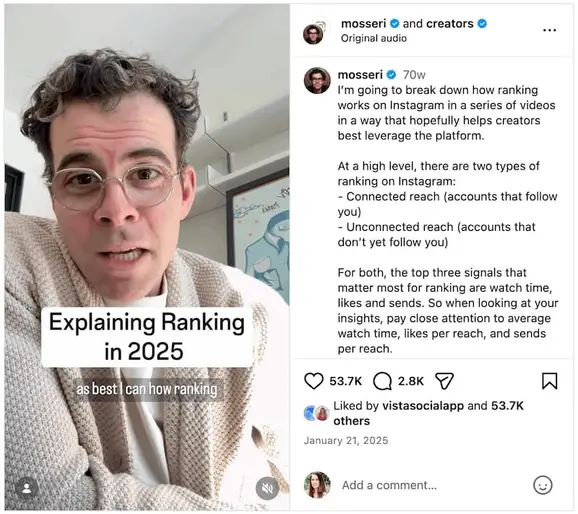
Mosseri broke down the signals that drive both connected reach (people who already follow you) and unconnected reach (people who don’t yet follow you).
As he put it: “They are how much we think someone is going to watch a video, and whether or not we think they’re going to like that video or they’re going to actually send that video to a friend.” Those three signals (watch time, likes, and sends) are the foundation for how Instagram decides what to show and to whom.
Instagram has also given users more direct control over what they see. The “Your Algorithm” feature, which went globally live in early 2026, lets users choose the topics Instagram shows them in Reels. That means your content isn’t just competing against behavioral signals anymore; it’s competing against explicit user preferences too.
That competition is getting tougher across the board. Reels supply has grown significantly while user attention has stayed flat. With more content fighting for the same amount of attention, discoverability matters more than ever.
That’s where Instagram SEO comes in. Voiceovers and captions with clear keywords now help surface content in Explore and Search, so treating Instagram partly as a search engine is becoming a real part of the strategy.
3. TikTok algorithm
TikTok’s For You Page is a big source of video views across the platform, which means your follower count matters less here than on any other network.
Other important factors include:
- Topical consistency: Accounts that focus on a single niche tend to send better reach signals than accounts posting across a number of unrelated topics
- Completion rate: Viewers watching your video all the way through are a big sign that you’re creating entertaining content, so focus on your hooks, but also ensure your pacing keeps people engaged
- TikTok SEO: TikTok is a search engine in its own right, and a well-optimized TikTok with relevant keywords can consistently drive views to your page
On the business side, the TikTok USDS Joint Venture was established in January 2026, with a US investor group led by Oracle, Silver Lake, and MGX taking a majority stake. ByteDance’s direct ownership was reduced to under 20%, and the algorithm is being retrained on US-hosted data.
4. LinkedIn algorithm
LinkedIn’s 2026 algorithm has followed the same social-to-interest graph shift as other platforms, but with a professional context layer that makes it feel distinct. The focus has moved from who you’re connected to toward what topics you’re engaging with.
Dwell time is now LinkedIn’s most important signal. A post someone reads for 30 seconds outperforms one with 50 quick likes, which has changed how content needs to be structured.
Native video generates up to two times more engagement than text-only posts, and the platform rolled out a short-form video feed in 2026. Document carousels also remain one of the highest-performing formats, earning strong dwell time from the swipe-through behavior.
Spam filtering has tightened considerably. Excessive hashtags, tagging unconnected people, and posting more than once per 12 hours all suppress distribution.
Personal profiles significantly outperform company pages for organic reach. Vista Social supports LinkedIn profile management natively, which is rare among social tools.
5. X/Twitter algorithm
X is aggressively prioritizing native vertical video in 2026, while text-only posts and posts with external links have been pushed down in distribution. If your brand isn’t creating video for X, you’re working against the algorithm’s current preferences.
The algorithm also evaluates post sentiment and the quality of replies a post generates. Posts that spark substantive conversation get boosted, while those generating toxic replies get suppressed. Beyond that, X works increasingly like a real-time search engine, with natural-language keywords in the first 100 characters helping discoverability.
6. YouTube algorithm
YouTube combines watch time and click-through rate more tightly than any other platform. High click-through with low watch time gets penalized as clickbait, so you need both signals working together.
Chapters and timestamps now influence search ranking directly, making them an easy optimization most creators still skip. The Shorts algorithm favors completion rate and rewatches, similar to TikTok. The broader YouTube algorithm still rewards long-form content that holds attention, but Shorts have become essential for channel growth and discovery.
7. Threads algorithm
Threads now uses a recommendation system closely integrated with Instagram’s interest graph. Your engagement on Instagram directly influences what you see on Threads, and vice versa.
The “Now” tab rewards joining trending discussions early, and getting in while a conversation is still building gives your posts distribution advantages. Threads posts can also surface on Mastodon and other ActivityPub networks through federation, giving content a longer lifespan.
Low-effort engagement (one-word replies, generic comments) actually hurts visibility here. The algorithm specifically rewards substantive replies that add to the conversation.
8. Pinterest algorithm
Pinterest is a search engine that happens to look like a social network, and understanding that distinction is the key to succeeding on the platform. Users come with intent, and AI-powered visual tagging matches Pins with searches even when your keywords don’t perfectly align.
Saves remain the most important engagement signal on Pinterest. A save tells the algorithm a user found the Pin valuable enough to return to, signaling genuine intent.
9. Bluesky algorithm
Bluesky takes a different approach entirely. The default feed is chronological with no algorithmic ranking, though custom algorithmic feeds built by independent developers are available and growing.
Followers and starter packs drive reach more than algorithmic recommendation here. Trust-graph features (Trust Lists, labelers) also influence visibility, and the platform is growing among tech, journalism, and creative communities.
10. Reddit algorithm
Reddit rewards posts that drive sustained discussion, not just upvotes. A post with 50 upvotes and 200 thoughtful comments outperforms one with 500 upvotes and three comments.
Unlike most platforms, Reddit doesn’t penalize older posts aggressively. Useful content can earn visibility for weeks or months after publishing, which makes Reddit especially valuable for search-driven strategies and B2B audiences.
11. Snapchat algorithm
Snapchat’s Spotlight rewards short, replay-worthy content, and discovery is driven by the Spotlight algorithm rather than the follow graph. Follower count matters less here than how your content performs with cold audiences.
AR lenses also get an algorithmic boost as Snapchat continues investing in augmented reality as a differentiator. For brands experimenting with AR, Snapchat’s algorithm actively rewards that investment.
How to beat the social media algorithm: What actually drives reach in 2026
Knowing how algorithms work is useful, but it doesn’t mean much if you can’t turn that knowledge into a daily workflow. These eight tactics are grounded in the universal signal stack and apply across every major platform.
1. Plan content natively per platform
Cross-posting with watermarks or wrong aspect ratios triggers distribution penalties everywhere. Vista Social’s multi-network publishing lets you create per-platform versions from one workspace, with native formatting and captions.
2. Engineer the first 60 minutes
Engagement velocity in the first hour determines whether a post breaks through to a wider audience. Reply to comments fast, comment on the post yourself, and notify your most engaged followers.
3. Pick a niche and stay there
The cross-niche penalty on TikTok can cost you reach. Instagram and YouTube also reward topical consistency, so staying focused in one niche beats sporadic posting across five.
4. Build for dwell time, not likes
Likes are down-weighted across platforms, and watch time and dwell time drive distribution now. That means strong hooks to earn the first three seconds, pacing that holds attention, and endings that justify a rewatch.
5. Optimize for sends and saves
On Instagram, sends are the top signal for unconnected reach. If your content isn’t worth sharing privately, the algorithm won’t share it publicly either.
6. Show up consistently and kill viral chasing
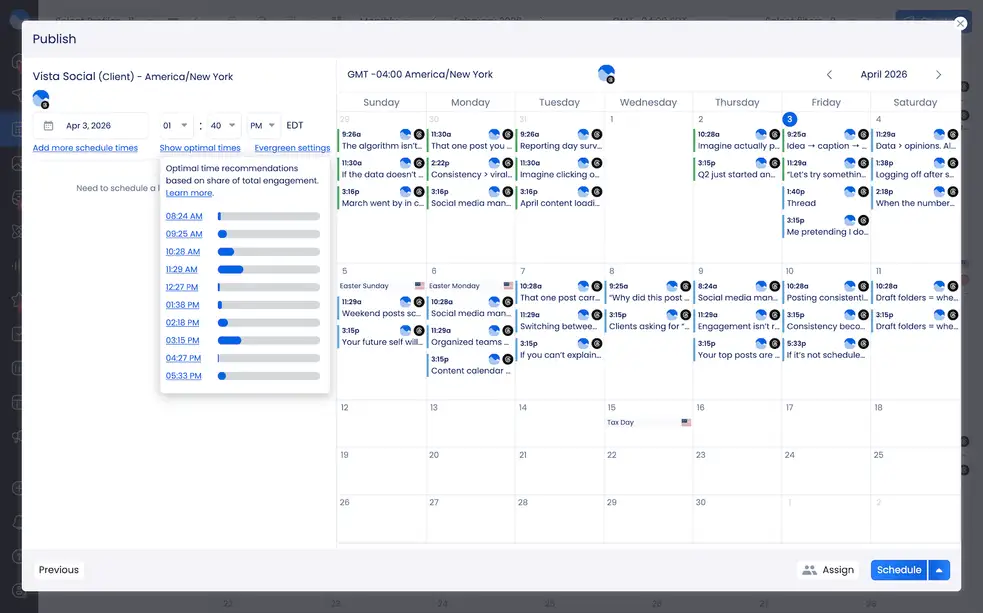
Consistent posting trains the algorithm’s signals more reliably than any single viral hit. Vista Social’s optimal posting times feature auto-calculates the best times per network based on your actual audience behavior.
For example, Vista Social’s own audience on Threads are usually active around 11:29 AM or 3:15 PM, making those the most optimal times for the team to schedule content to be able to reach many of our target audience.
7. Use the algorithm’s preferred formats per platform
Reels and carousels on Instagram, long-form on TikTok, native video on LinkedIn, vertical video on X. Vista Social’s AI Assistant helps create per-platform captions matched to each network’s tone.
8. Use founder and employee-led distribution
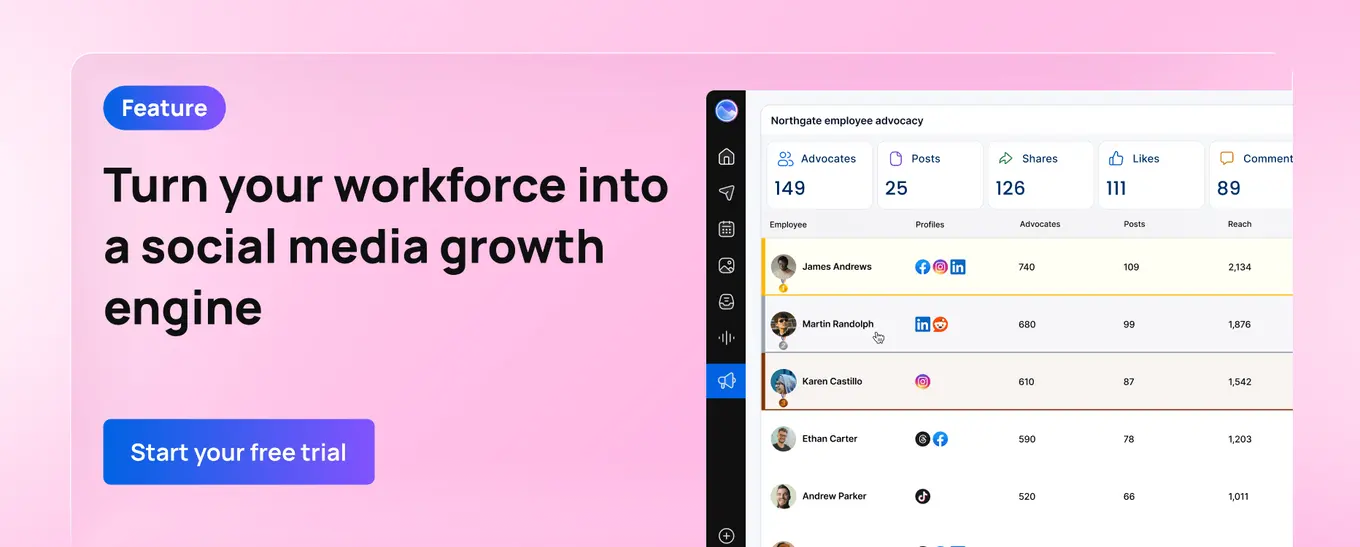
Brand pages have lost organic reach almost universally, so founder-led content and employee accounts carry the bulk of distribution now. Vista Social’s Employee Advocacy module distributes approved content through employee networks at scale.
Try Vista Social for free
A social media management platform that actually helps you grow with easy-to-use content planning, scheduling, engagement and analytics tools.
Get Started NowAbout the Author

Content Writer
Russell Tan is a content marketing specialist with over 7 years of experience creating content across gaming, healthcare, outdoor hospitality, and travel—because sticking to just one industry would’ve been boring. Outside of her current role as marketing specialist for Vista Social, Russell is busy plotting epic action-fantasy worlds, chasing adrenaline rushes (skydiving is next, maybe?), or racking up way too many hours in her favorite games.
Loading related tools...

The most complete social media management platform for teams who demand more.





Tools
PublishingAnalyticsEngagementIntegrations
FacebookInstagramLinkedInRedditSnapchatThreadsTikTokX (Twitter)YouTubeMCPVista Page (link-in-bio)All IntegrationsCopyright © 2026 Vista Social LLC. All Rights Reserved.
Social media algorithm don’ts: What no longer works
A lot of the tactics that drove results in 2022 and 2023 are now either ineffective or actively hurting your reach. If any of these are still in your playbook, it’s time to drop them: