

Published on February 3, 2026
13 min to read
Vista Social vs. Later: Which Tool Fits Your Needs?

Summarize with AI

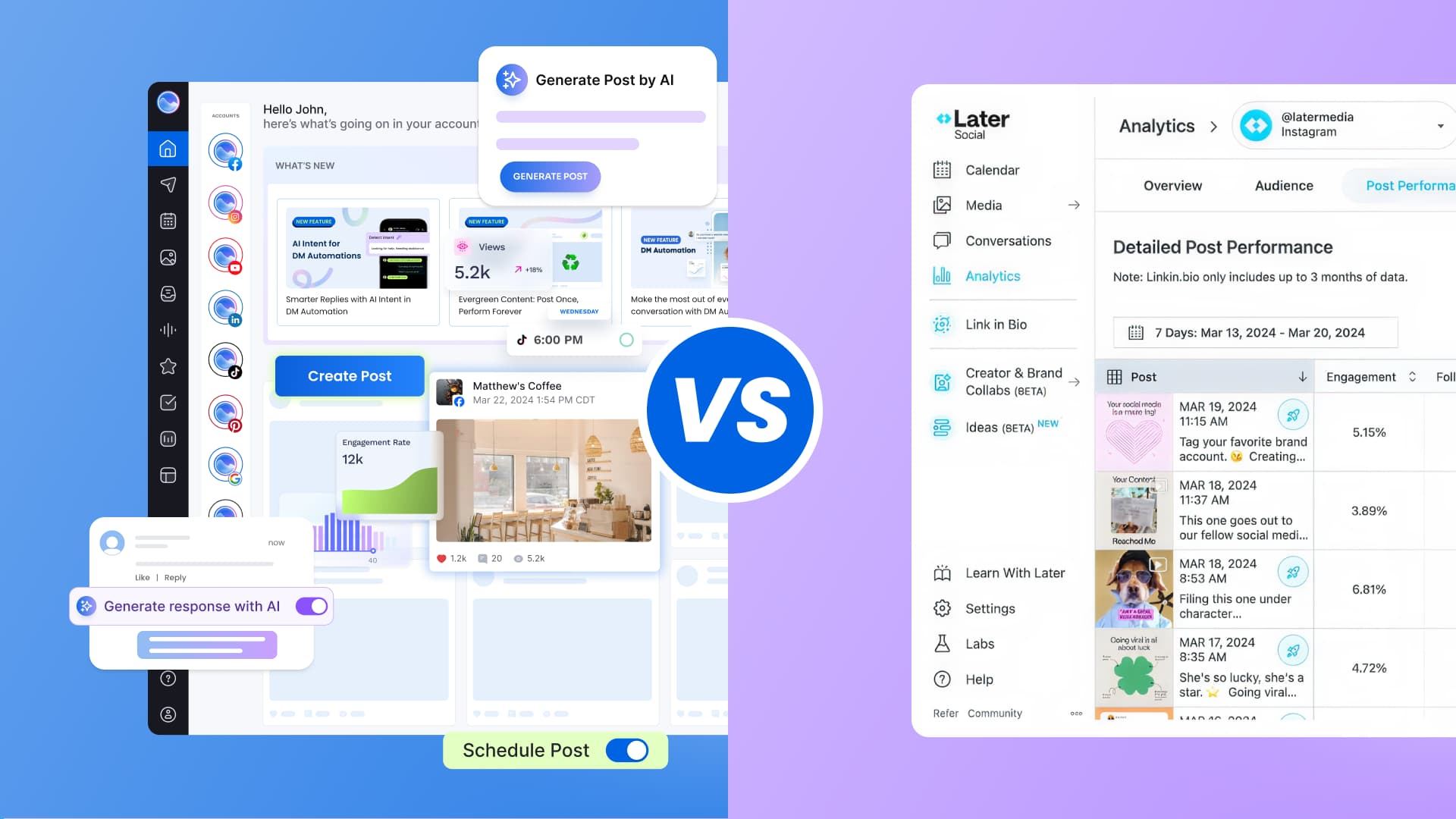
Table of contents
Summarize with AI

ChatGPT

Claude

Perplexity
Share

Vista Social

X (Twitter)


Finding the right social media management tool can feel overwhelming when you’re comparing dozens of options. Vista Social and Later are two platforms that come up frequently in these searches, but they take very different approaches to managing your social presence.
Later started as an Instagram scheduling tool and has grown to include more platforms and features over time. Vista Social was built from the start as a complete social media management platform with tools for publishing, analytics, engagement, and more.
Both platforms can help you schedule content and track performance, but the similarities end there. This guide walks through how Vista Social and Later compare across 11 key feature categories so you can see which one actually fits your needs and budget.
Table of contents
Vista Social vs. Later: Comparison table
Here’s an overview of how Vista Social and Later compare across the main features most social media managers need:
| Feature | Vista Social | Later |
| Social media publishing | ✅ Yes | ✅ Yes |
| Social media analytics | ✅ Yes | ✅ Yes |
| Social inbox | ✅ Yes | ⚠️ Limited |
| Social listening | ✅ Yes | ⚠️ Limited |
| Link-in-bio | ✅ Yes | ✅ Yes |
| Team collaboration | ✅ Yes | ✅ Paid plans only |
| Artificial intelligence | ✅ Yes | ⚠️ Limited |
| Automation | ✅ Yes | ⚠️ Limited |
| Employee advocacy | ✅ Yes | ❌ No |
| Influencer marketing | ⚠️ Via listening | ✅ Separate product |
| Integrations | 13+ networks | 8 networks |
| Pricing | Starts at $79/month | Starts at $25/month |
| G2 rating | 4.8/5 stars | 4.5/5 stars |
Vista Social includes more features across the board, while Later focuses primarily on visual content planning and Instagram management. The differences become more apparent when you look at each feature in detail.

Vista Social vs. Later: Which tool fits your needs?
Let’s break down how these platforms compare in the areas that matter most for your daily social media management work.
Social media publishing
Both platforms handle the core scheduling and publishing features you’d expect from a social media scheduling tool. You can create posts, schedule them for later, and publish to multiple accounts at once. The real differences show up in platform coverage and posting limits.
One important difference is posting limits. Vista Social offers unlimited posts on every plan, so you can schedule as much content as you need without worrying about hitting a cap. Later has different limits depending on your plan. The Starter plan allows 30 posts per profile monthly, Growth allows 180, and only the Scale plan offers unlimited posting.
Both platforms recommend the best times to post based on your audience data. Vista Social includes bulk scheduling tools that let you upload up to 100 posts at once via CSV file, which saves time when you’re planning campaigns or working with editorial calendars. Later doesn’t support bulk CSV uploads, so larger campaigns require more manual scheduling.
Vista Social’s publishing features include AI caption generation with unlimited usage on Advanced plans and higher.
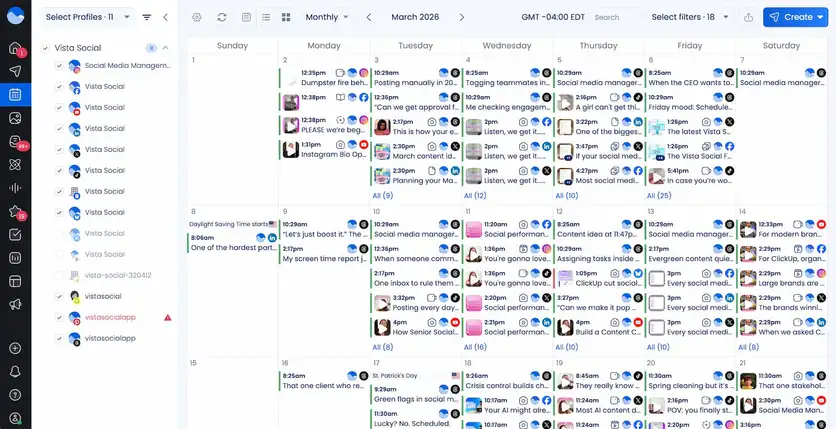
You can also integrate trending audio for Reels and TikTok, import content from RSS feeds, and use browser extensions to share content you find online. The Smart Publishing feature can automatically generate content based on topics you specify.
Later excels at visual planning, particularly for Instagram. The visual calendar shows exactly how your Instagram grid will look before you publish, which helps maintain aesthetic consistency.
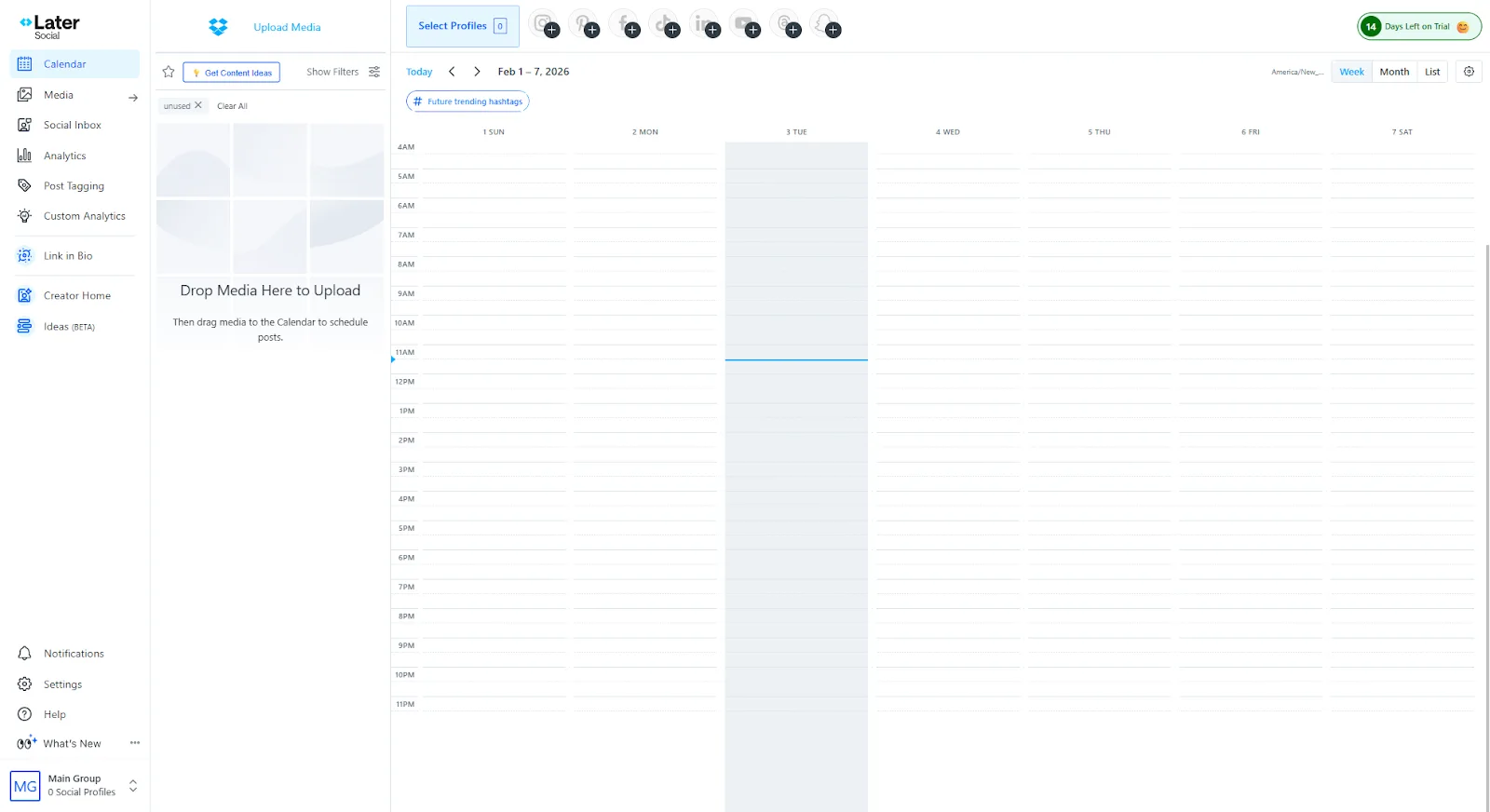
You can drag images from the media library onto the calendar and add captions directly from there. This Instagram-first approach makes it a strong choice for brands where visual consistency is the top priority.
However, there are some differences in Instagram functionality between the platforms. Later doesn’t support publishing to personal Instagram profiles and requires notification publishing for Instagram Stories on creator accounts. Vista Social supports personal profiles through mobile app notifications and can auto-publish to both creator and business profiles.
Social media analytics
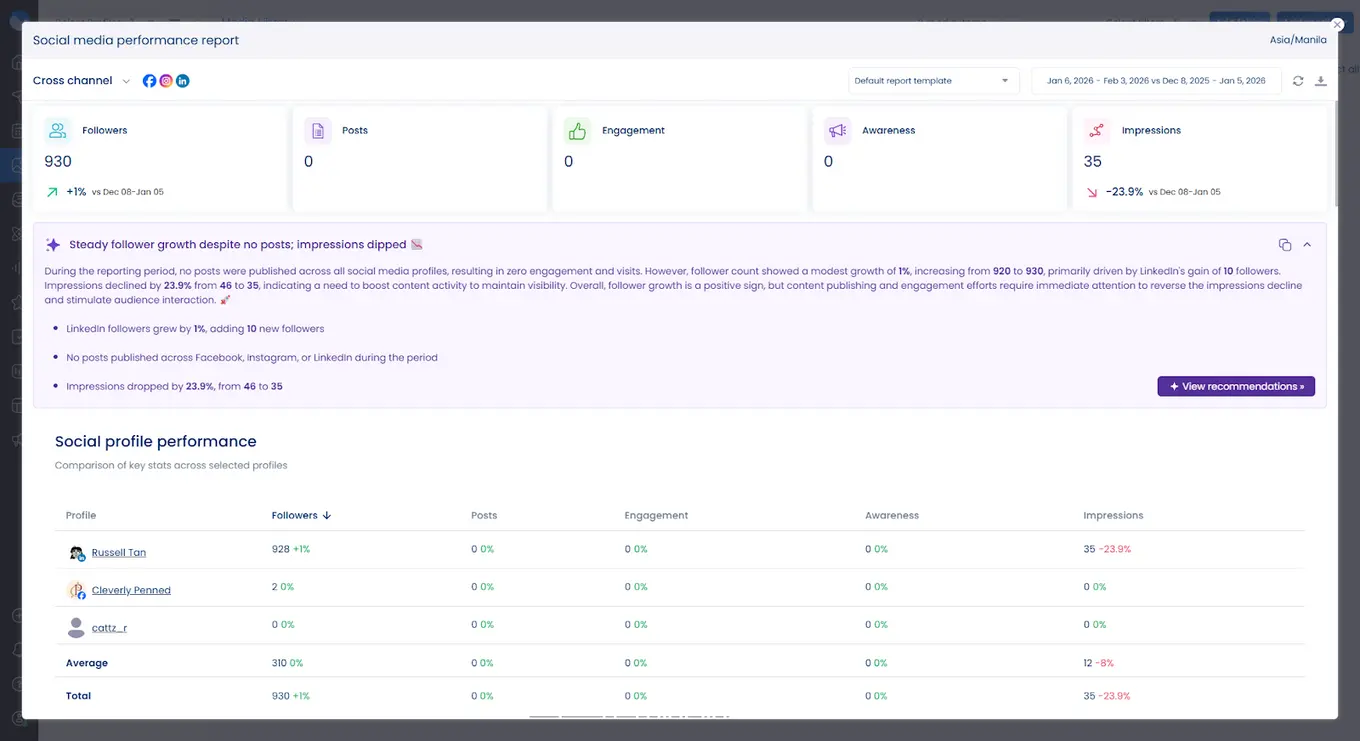
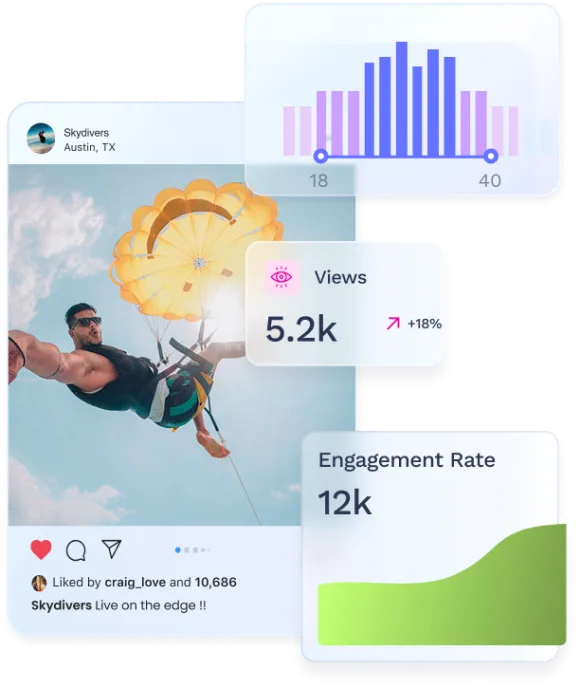
Understanding what’s working in your social media strategy requires good analytics. Vista Social provides enterprise-grade analytics that include competitor analysis, sentiment detection, predictive trends, and cross-platform reporting. Everything appears in a unified dashboard so you can see performance across all your connected networks at once.
The platform offers automated scheduled reports that you can export as PDF, CSV, or Excel files. Google Analytics integration connects your social performance to website traffic, and custom report builders with branded templates make it easier to share results with clients or stakeholders.
Vista Social’s social analytics tools provide deeper insights for teams that need to track engagement on social media across multiple platforms. They also provide AI summaries that give upfront analysis and recommendations for improvement.
Later’s analytics work well for Instagram-focused creators who need straightforward metrics without extensive historical data.
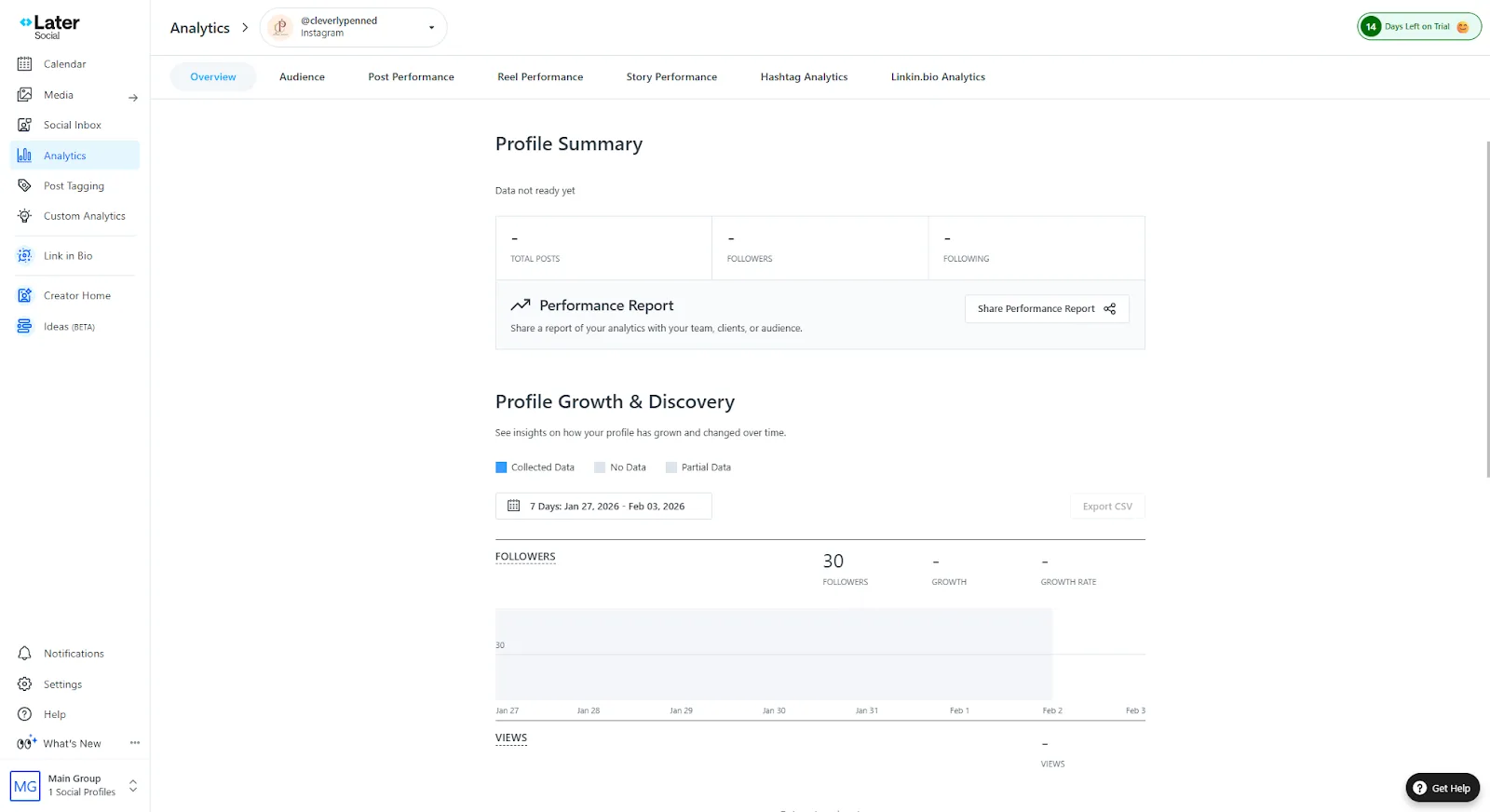
Later covers the fundamentals with post performance tracking, engagement metrics, and audience insights. However, data retention varies significantly by plan. The Starter plan keeps only 3 months of historical data, Growth extends to 1 year, and the Scale plan provides 2 years of retention. This can be limiting if you need to analyze long-term trends or year-over-year comparisons.
Later does provide helpful analytics for their Linkin.bio tool, showing clicks, views, and geographic data. This helps creators understand which bio links drive the most traffic and conversions.
Social inbox
Managing conversations across multiple social media platforms can get complicated quickly when you’re switching between different apps and browser tabs. A unified inbox brings everything together in one place so you don’t miss messages or comments.
Vista Social aggregates messages, comments, mentions, and reviews from all your connected platforms into a single inbox. The platform provides real-time syncing for Facebook and Instagram, which means you can respond to messages as soon as they come in. The built-in CRM tracks your conversation history with each contact, so you always have context when you’re replying.
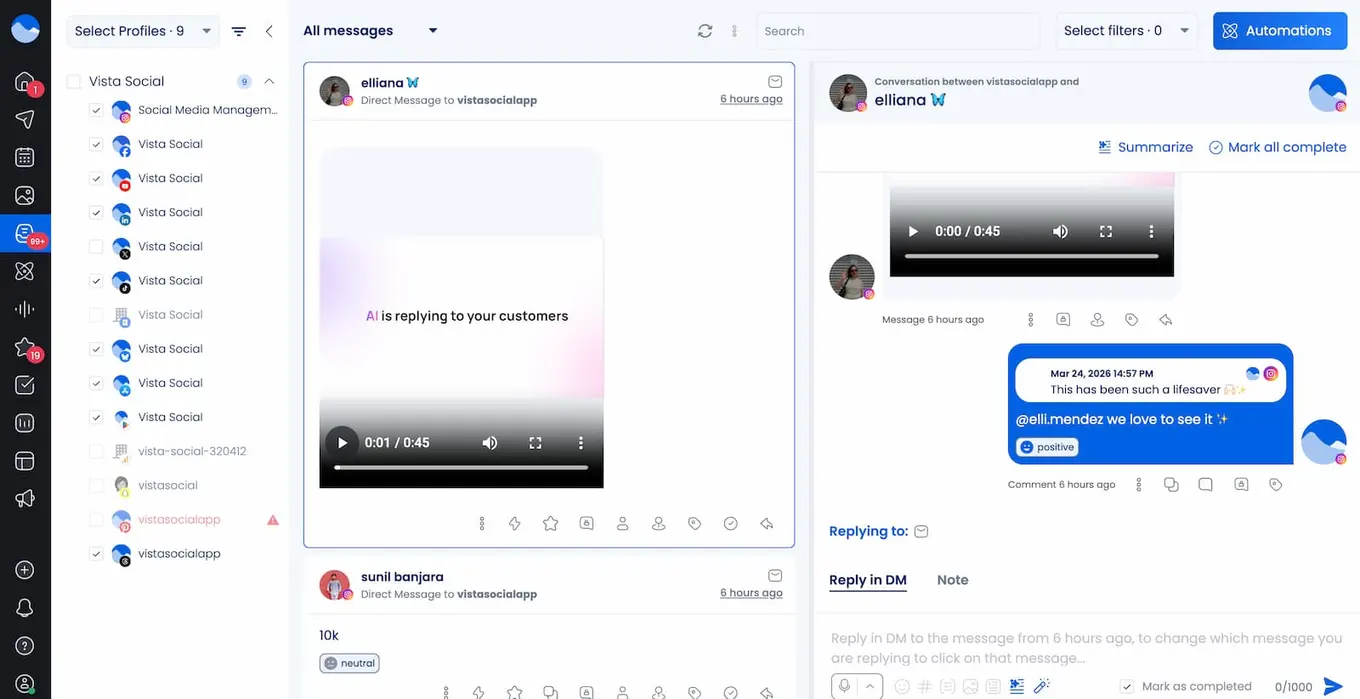
Team features make it easier to collaborate on responses. You can assign messages to specific team members, add internal notes that only your team can see, and work together on drafting replies. The AI Assistant can suggest responses to help you reply faster, and Zendesk integration connects your social conversations to your support ticket system.
Later offers conversation management starting on the Growth plan, which costs $37.50 per month with annual billing. The coverage includes Instagram DMs and comments, Facebook DMs and comments, and TikTok comments. If you’re active on other platforms like LinkedIn, Pinterest, YouTube, Threads, or Snapchat, you’ll need to manage those conversations separately.
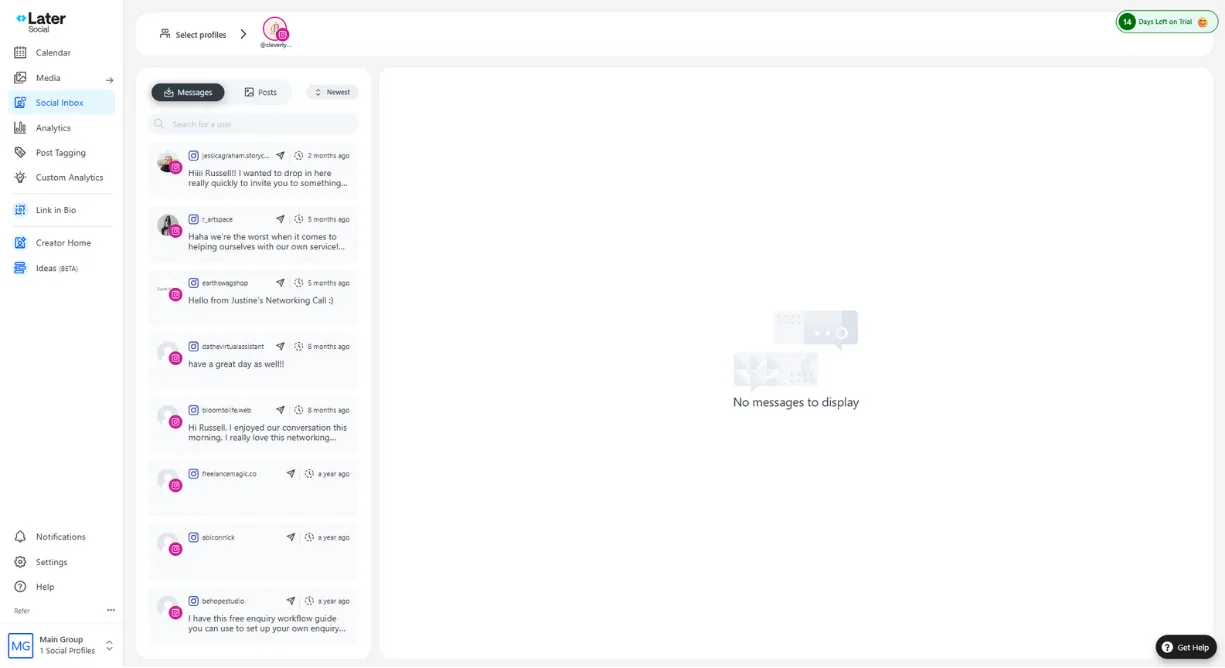
Vista Social’s approach to social media inbox management gives you a truly unified system for handling all your social conversations. Later’s inbox works if you’re primarily focused on Instagram and Facebook, but the limited platform coverage means it won’t replace all your other tools.

Social listening
Social listening helps you understand what people are saying about your brand beyond the posts and comments on your own profiles. It’s valuable for catching reputation issues early, finding new opportunities, and understanding how your audience really feels about your brand.
Vista Social includes social media listening on all paid plans. You can monitor your own channels as well as external sources like news sites, review platforms, and general web search results. The platform lets you track specific keywords, filter conversations by sentiment, monitor what your competitors are doing, and discover potential influencers based on what they’re already saying about your industry.
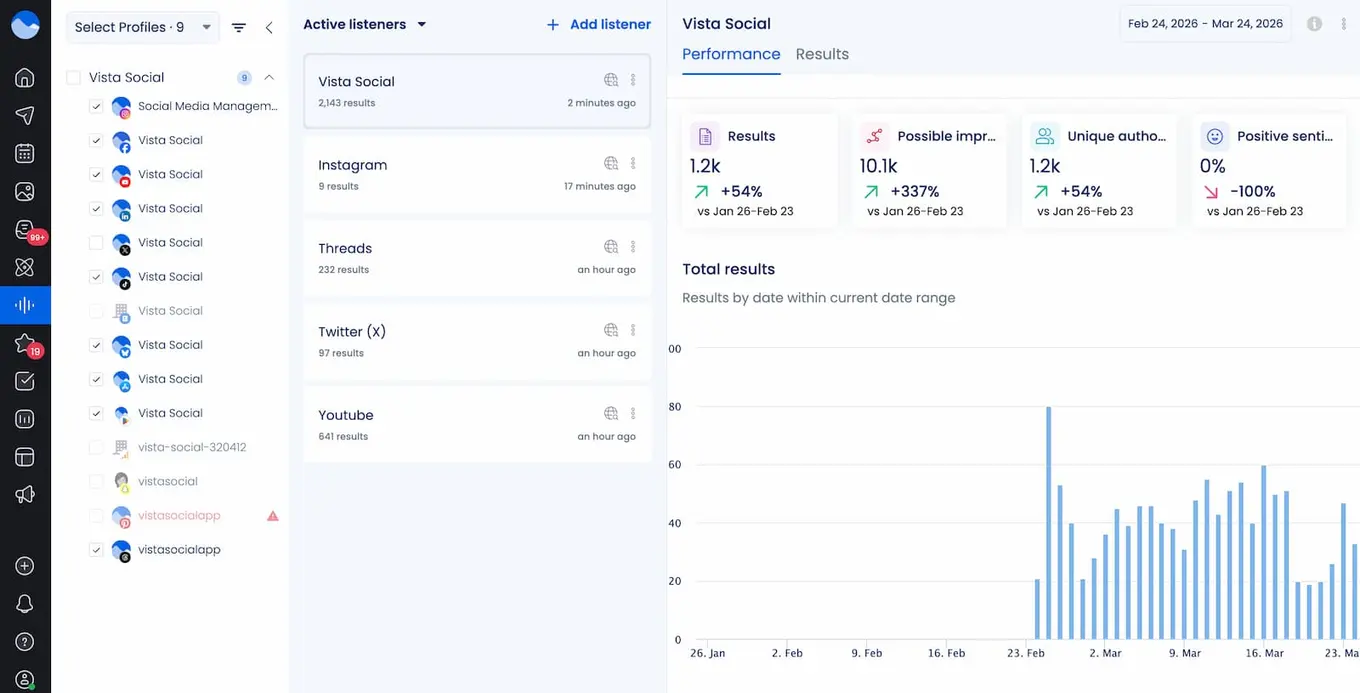
The social listening analytics turn all those mentions into actionable insights. You can spot trends before they take off, catch potential PR problems early, and find conversations where your brand can add value.
Later launched social listening as an AI-powered feature in August 2024, but it’s only available on the Scale plan, which starts at $82.50 per month with annual billing. The tool can track brand mentions, analyze sentiment, and monitor up to 20 competitors.
However, the monitoring is currently focused on Instagram (excluding Stories) and limited to 30 unique keywords per 7-day period per profile. For comprehensive brand monitoring across platforms, these restrictions can be significant.
Vista Social’s social media listening platforms provide broader coverage at lower price points. Later’s listening feature is more limited in scope and only available on the highest-tier plan.
Link-in-bio
Both platforms offer link-in-bio tools that let you create a landing page to share in your social media profiles.
Vista Social’s Vista Page provides fully customizable microsites with support for custom domains and free SSL certificates. You can integrate payment processing through PayPal and Stripe, connect booking systems like Calendly, add lead capture forms, and use Google Tag Manager for tracking.
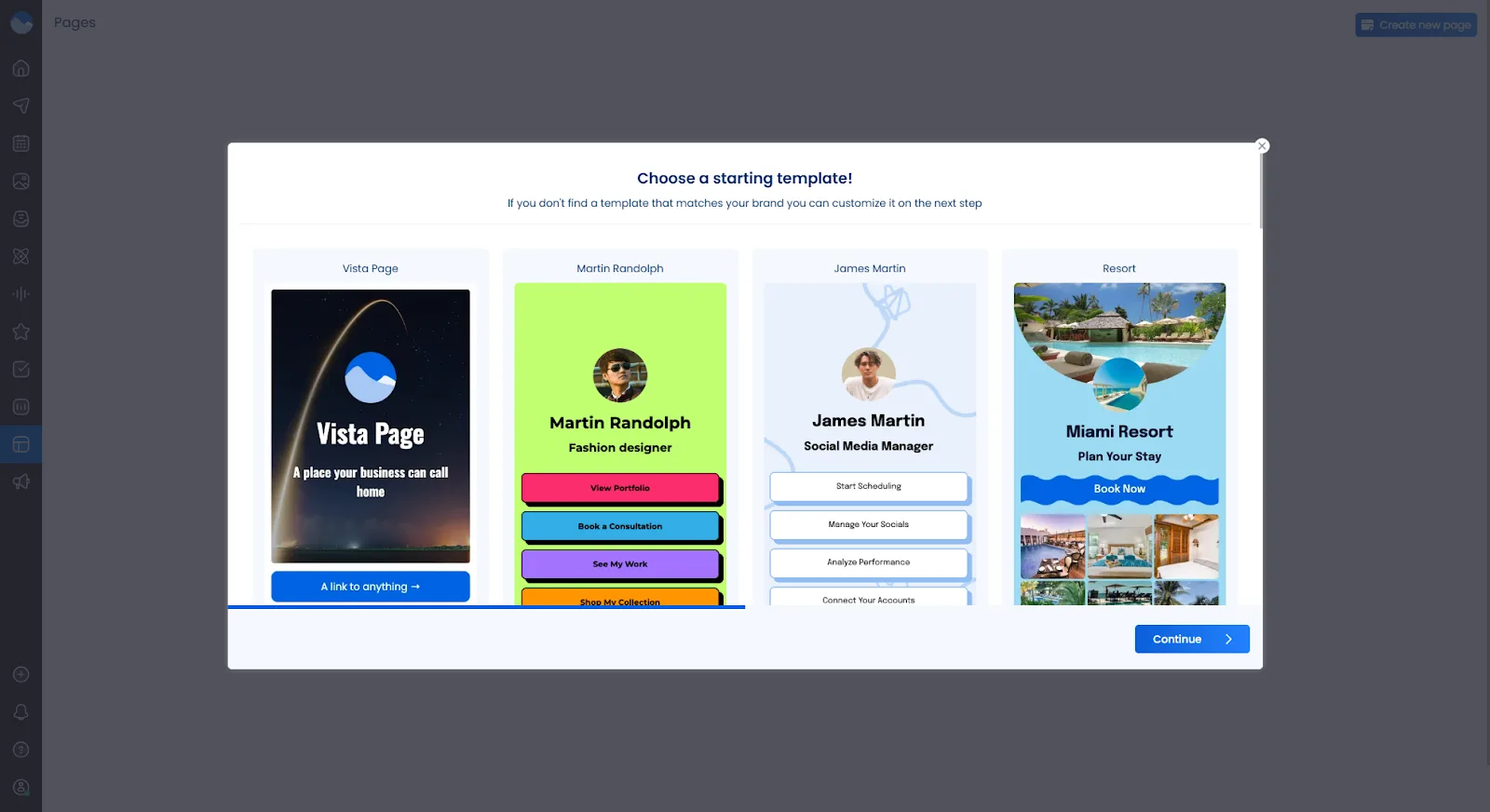
The platform allows unlimited Vista Pages, which is helpful if you’re managing multiple brands or clients.
Later’s Linkin.bio has been around longer and is one of the most popular link in bio tools on the market. It’s included free on all plans and offers clickable Instagram and TikTok post grids, up to 5 links per post on Growth and Scale plans, custom themes, featured media banners, Shopify product tagging, and Mailchimp integration.
The analytics show clicks, views, and geographic data, and you can customize SEO elements like title tags and meta descriptions to help your bio page show up in search results.
Both solutions work well for their intended purposes. Later’s link-in-bio tool benefits from years of development and an Instagram-centric design that many creators appreciate. Vista Page offers more advanced functionality like custom domains and payment integration for businesses that need those capabilities.
Team collaboration
How a platform handles team collaboration can determine whether it scales with your business or becomes a bottleneck as you grow.
Vista Social offers unlimited users on its higher-tier plans without charging per seat. You can set role-based permissions to control who can create posts, approve content, or just view the calendar. Post approval workflows help ensure quality control before anything goes live. The shared content calendar keeps everyone aligned on what’s being published and when.
Internal notes with @mentions let team members communicate directly within the platform about specific posts or campaigns. You can assign tasks to specific team members and use the productivity reporting to see how the team is performing. SAML 2.0 SSO support meets enterprise security requirements for larger organizations.
Later takes a different approach with fixed user limits per plan. Collaboration features like approval workflows and access groups require the Growth plan or higher.
The math matters here. A 10-person team on Later Scale would pay $82.50 for the base plan plus $22.50 for 6 additional users, totaling $105 per month. Vista Social’s Advanced plan costs $149 per month but includes 10 users plus significantly more features like DM automation and employee advocacy.
For growing teams and agencies, Vista Social’s unlimited user model provides better value. For solo creators or very small teams, Later’s lower entry price might make more sense depending on which features you need.
Artificial intelligence
AI features can significantly speed up content creation if they’re implemented in a way that’s actually useful.
Vista Social’s AI Assistant runs on ChatGPT and offers unlimited usage on Advanced plans and above. You can generate captions, translate content into different languages, create reply suggestions for messages in your inbox, and insert fact-checked statistics into your posts.
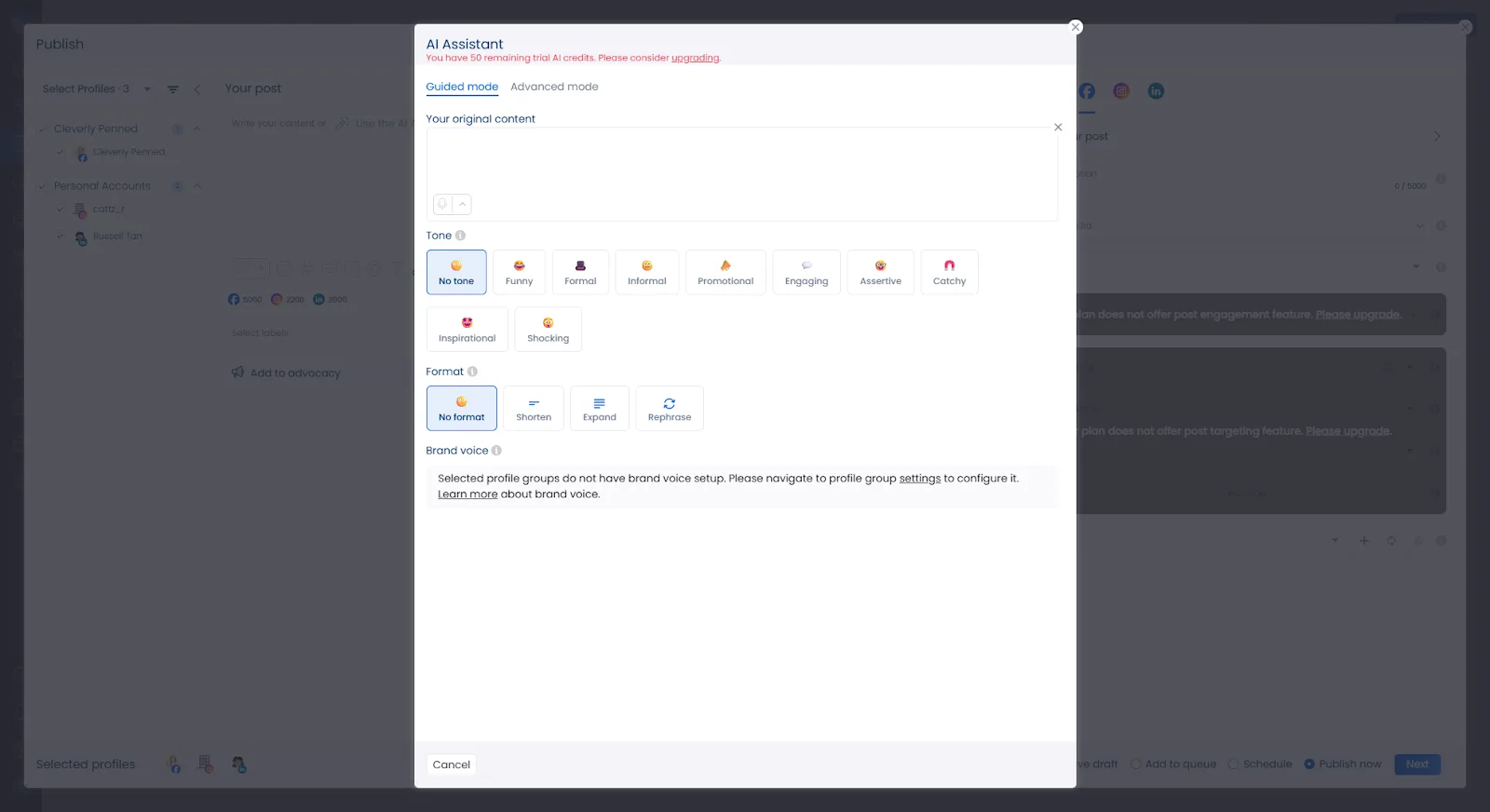
The AI maintains your brand voice across everything and adapts between guided mode for beginners and advanced mode for experienced users. The AI in social media features are integrated throughout the platform in publishing, inbox management, and reporting.
Vista Social also offers AI connectors through MCP that allow users to do tasks in Vista Social without leaving their ChatGPT or Claude interface, making it even more efficient to manage social media.
Later’s AI features operate on a credit-based system. You get 5 credits monthly on Starter, 50 on Growth, and 100 on Scale. One credit generates either 3 content ideas or 1 caption. If you’re creating daily content across multiple platforms, you could easily use 30-60 credits per month just on caption generation. When you run out, you can purchase additional credits at $3.75 per month for 100 more.
The difference between unlimited AI and metered credits becomes significant for teams that post frequently. With Vista Social, you don’t have to think about whether you can “afford” to use AI on a particular post.
Automation
Automation features determine whether a platform helps you save time or just helps you organize your manual work.
Vista Social provides DM automations that automatically reply to comments, DMs, and mentions across Facebook, Instagram, and TikTok. The Flow Builder lets you create trigger-based workflows using keywords or AI intent detection.
You can automatically collect lead data, send DM links when people comment on your posts, set up follow incentive automations, and schedule everything by specific days and times. All the automations comply with Meta and TikTok API policies.
Later offers basic automation features like auto-publishing scheduled posts, Best Time to Post recommendations, and first comment scheduling for Instagram. These features help with the scheduling workflow, but the platform doesn’t include advanced automation capabilities like auto-responses to DMs and comments, trigger-based workflows, or lead capture automations.
For teams looking to understand how to use DM automation to scale their engagement without adding staff, Vista Social provides those advanced capabilities. Later’s automation focuses on publishing efficiency rather than engagement automation.

Employee advocacy
Employee advocacy programs turn your team members into brand ambassadors by making it easy for them to share company content on their personal social profiles.
Vista Social’s employee advocacy program lets employees share, repost, like, and comment on brand content using pre-approved messaging. This keeps everything compliant while expanding your organic reach through your employees’ networks.
The platform includes leaderboards and gamification features to encourage participation, and analytics track adoption rates, organic reach, and engagement that comes from employee shares. The dedicated Advocacy plan costs $199 per month for up to 25 employees, and standard plans include 3 free advocate seats.
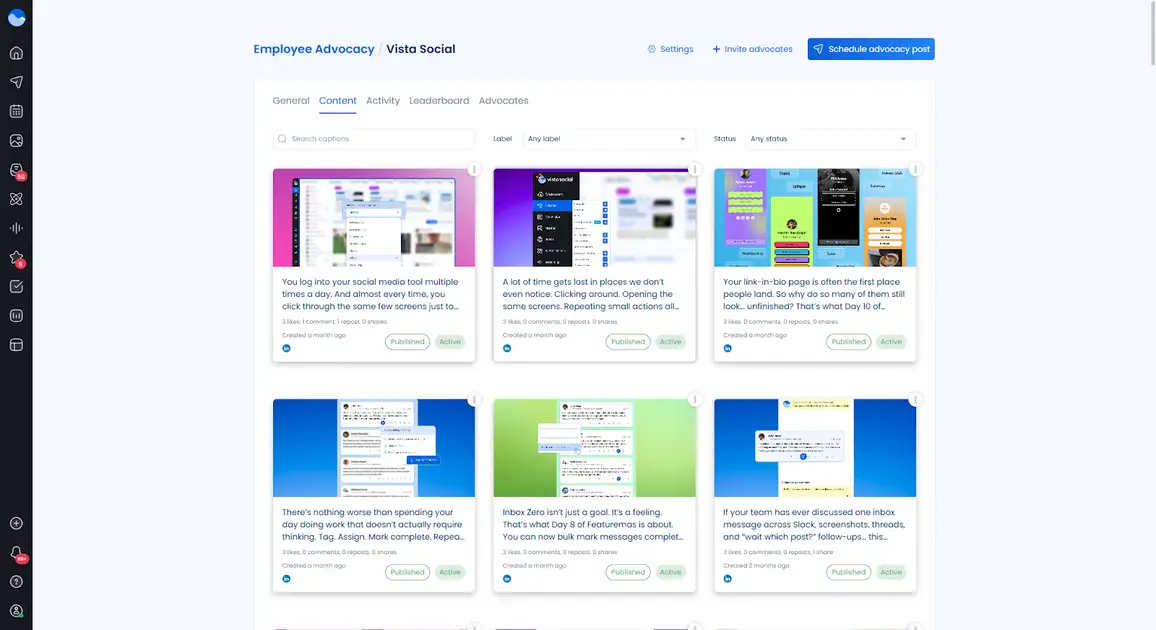
Later doesn’t offer employee advocacy features. If you need this capability, you’ll have to use a separate tool. For context on what’s available in the market, you can review these employee advocacy tools to see what other platforms offer.
Vista Social includes employee advocacy as part of its platform, while Later doesn’t address this use case at all.
Influencer marketing
The two platforms take completely different approaches to influencer marketing.
Later Influence operates as a separate product from Later’s social media management tools, with custom pricing that requires contacting their sales team. The platform provides access to a database of 10+ million creators, AI-powered discovery with 20+ filters, campaign management tools, content approval workflows, and performance analytics.
They also feature an integration with Mavely, which enables affiliate link tracking. This is a comprehensive influencer marketing solution, though it requires a separate subscription beyond your social media management plan.
Vista Social approaches influencer marketing through its integrated tools rather than offering a dedicated platform. You can use social listening to identify potential influencers who are already talking about your industry, schedule and track influencer campaign content through the unified calendar, manage content submissions through approval workflows, and measure campaign performance through the analytics dashboard.
Organizations running extensive influencer programs with large creator networks might prefer Later Influence’s dedicated tools and creator database. Those looking for basic influencer features within their social media management platform will find Vista Social’s integrated approach sufficient for smaller-scale influencer work.
Integrations
The platforms you can connect determine whether you need one tool or several to manage your full social presence.
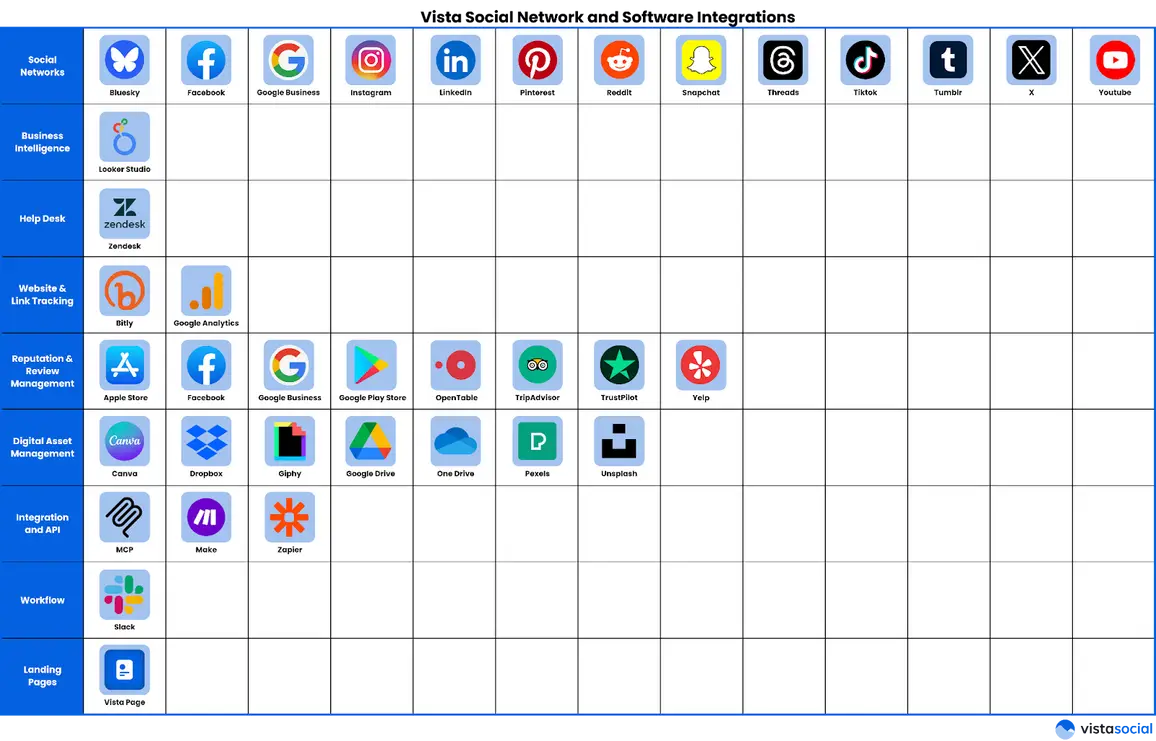
Vista Social supports 13+ social networks:
- Facebook (Pages, Groups, Messenger)
- Instagram (Feed, Reels, Stories, DMs)
- TikTok
- X (Twitter)
- YouTube
- Threads
- Bluesky
- Snapchat
- Tumblr
- Google Business Profile
For review management, the platform connects to:
- Yelp
- TripAdvisor
- OpenTable
- Trustpilot
Third-party integrations include:
- Canva
- Google Drive
- Dropbox
- OneDrive
- Zapier
- Make
- Slack
- Zendesk
- Salesforce
- HubSpot
- Google Analytics, and more
Later supports 8 social networks:
- TikTok
- YouTube
- Threads
- Snapchat
Third-party integrations include:
- Canva
- Google Drive
- Dropbox
- Google Analytics
- Mailchimp
- Shopify
- Mavely
Vista Social’s broader platform coverage serves brands that maintain an active presence on multiple platforms. If you’re using emerging platforms like Bluesky or community platforms like Reddit, Later won’t support those needs. For a broader perspective on what’s available, check out this roundup of social media tools to see how these platforms compare to other options in the market.
Pricing
Understanding the real cost of each platform requires looking beyond the starting price to see what’s actually included. Take note that these prices are billed annually.
Vista Social pricing:
- Professional: $64/month; 15 profiles, 3 users, bulk scheduling, listening, review management
- Advanced: $120/month; 30 profiles, 6 users, advanced workflows, advanced DM automations, integrations with Zapier, Make and MCP
- Scale: $304/month; 70 social profiles, 10 users, advanced plan features, white label setup, unlimited AI Assistant
- Enterprise: Custom pricing; unlimited profiles, unlimited users, premium analytics, custom integrations
Later pricing (annual billing):
- Starter ($18.75/month): 1 social set (8 profiles), 1 user, 30 posts per profile
- Growth ($37.50/month): 2 social sets (16 profiles), 2 users, 180 posts per profile
- Scale ($82.50/month): 6 social sets (48 profiles), 4 users, unlimited posts
Both platforms offer 14-day free trials and 50% nonprofit discounts. Later requires a credit card to start your trial, while Vista Social doesn’t.
Later’s starting price looks lower, but the full cost depends on how many users you have and which features you need. Later Scale at $82.50 doesn’t include employee advocacy, comprehensive social listening, or DM automations. Vista Social Advanced at $149 includes all those features plus unlimited AI and 10 users.
Later Influence requires separate custom pricing for influencer marketing. Additional users beyond your plan limits cost $3.75 per month each.
For help deciding which features you actually need, see these social media planning tools to understand what capabilities matter most for different types of businesses and teams.
Try Vista Social for free
A social media management platform that actually helps you grow with easy-to-use content planning, scheduling, engagement and analytics tools.
Get Started NowAbout the Author

Content Writer
Russell Tan is a content marketing specialist with over 7 years of experience creating content across gaming, healthcare, outdoor hospitality, and travel—because sticking to just one industry would’ve been boring. Outside of her current role as marketing specialist for Vista Social, Russell is busy plotting epic action-fantasy worlds, chasing adrenaline rushes (skydiving is next, maybe?), or racking up way too many hours in her favorite games.
Loading related tools...

The most complete social media management platform for teams who demand more.





Tools
PublishingAnalyticsEngagementIntegrations
FacebookInstagramLinkedInRedditSnapchatThreadsTikTokX (Twitter)YouTubeMCPVista Page (link-in-bio)All IntegrationsCopyright © 2026 Vista Social LLC. All Rights Reserved.